
You Don’t Have a Delivery Problem — You Have a Decision Problem
Slow decisions cost more than bad ones.
By Incountr
Introduction: The Real Reason Delivery Feels Broken
If you ask most organizations why delivery is slow, you’ll hear familiar answers:
“We need better planning.”
“Execution isn’t consistent.”
“Teams aren’t aligned.”
“We need better tools.”
But here’s the uncomfortable truth:
Most delivery problems are not execution problems — they’re decision problems.
Projects stall not because teams can’t deliver, but because they’re waiting. Waiting for approvals. Waiting for clarity. Waiting for someone to decide.
And that waiting has a name: decision latency.
Decision latency is the silent killer of transformation. It doesn’t show up in dashboards. It’s rarely tracked. But it quietly erodes momentum, inflates costs, and frustrates teams.
If your organization feels slow, it’s not because people aren’t working hard enough.
It’s because decisions aren’t being made fast enough.
What Is Decision Latency (And Why It Matters More Than You Think)
Decision latency is the time it takes to move from “we need to decide” to “a decision has been made.”
Simple in theory. Devastating in practice.
How Decision Latency Shows Up in Organizations
You’ve seen it before:
A feature is ready—but waiting for stakeholder sign-off
A roadmap is drafted—but stuck in alignment discussions
A risk is identified—but no one wants to own the call
A meeting ends with: “Let’s take this offline”
On the surface, these feel like minor delays. But they compound.
The Hidden Impact of Decision Latency
Decision latency creates a ripple effect across the organization:
Slower time-to-market → competitors move first
Increased delivery costs → teams idle or rework
Lower morale → teams feel blocked and disempowered
Reduced innovation → ideas die in approval loops
Every delayed decision is a tax on progress.
And unlike technical debt, decision debt accumulates quietly—until it becomes impossible to ignore.
The True Cost of Slow Decisions vs. Bad Decisions
Organizations often optimise for making the right decision. But in doing so, they sacrifice something more valuable:
Speed.
Let’s reframe the trade-off.
Fast vs. Slow Decision-Making
Approach Outcome:
Fast, imperfect decisions Learn quickly, adjust, move forward
Slow, “perfect” decisions Miss opportunities, lose momentum
Why Slow Decisions Are More Expensive
Opportunity cost
While you’re deciding, competitors are executing.Compounding delays
One delayed decision blocks multiple downstream activities.False sense of safety
Waiting feels risk-averse—but it often increases risk over time.Lost learning cycles
You can’t learn from a decision you haven’t made.
Indecision is not neutral—it’s an active cost.
In fast-moving environments, the ability to course-correct is more valuable than the ability to predict perfectly.
Why Enterprises Struggle to Make Decisions
If the problem is so obvious, why do organizations struggle to fix it?
Because decision-making is not just a process issue—it’s a structural and cultural one.
1. Diffused Accountability
Multiple stakeholders involved
No clear decision owner
Consensus mistaken for accountability
Result: Everyone contributes. No one decides.
2. Over-Governance and Risk Aversion
Layer upon layer of approvals
Escalation as the default response
Fear of making the wrong call
Result: Decisions slow down to avoid blame.
3. Misaligned Incentives
Leaders optimise for their domain, not the whole system
Success metrics encourage caution over speed
Result: Decisions are delayed to protect local outcomes.
4. Decision Escalation Culture
Teams push decisions upward unnecessarily
Leaders become bottlenecks
Result: Senior leadership becomes the constraint.
5. Lack of Decision Clarity
Unclear who owns what
Undefined boundaries
Ambiguous authority
Result: Decisions get stuck in ambiguity.
Who Really Owns Decisions? (Spoiler: It’s Often Unclear)
Ask a simple question in most organizations:
“Who owns this decision?”
You’ll often get:
“It’s a shared decision”
“We need alignment first”
“Let’s bring in more stakeholders”
These sound collaborative—but they’re usually signals of unclear ownership.
Common Anti-Patterns
The Committee Decision
Everyone weighs in. No one is accountable.The Perpetual Meeting Loop
Decisions are deferred to the next discussion.The Escalation Trap
Decisions pushed higher, even when unnecessary.The Consensus Illusion
Agreement is required before action.
Ownership is not about who is involved—it’s about who is accountable.
If everyone owns it, no one owns it.
The Decision Ownership Framework
To fix decision latency, you don’t need more process.
You need clarity.
Here’s a simple, practical framework.
1. Define the Four Roles in Every Decision
Every decision should have clearly defined roles:
Decision Owner
Accountable for making the decision
Owns the outcome (good or bad)
Contributors
Provide input, expertise, and data
Do not make the final call
Approvers (Use Sparingly)
Only required for high-risk or regulated decisions
Should be minimal to avoid bottlenecks
Informed
Kept in the loop after the decision is made
Clarity of roles removes ambiguity—and ambiguity is the enemy of speed.
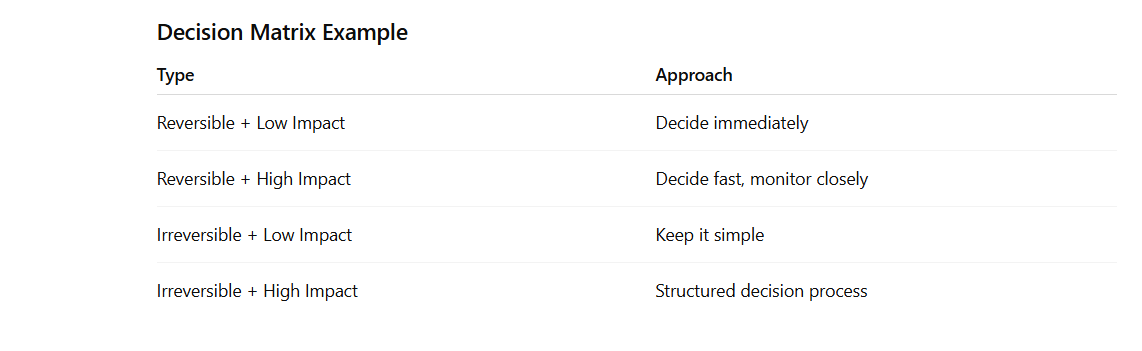
2. Classify Decisions (Not All Decisions Are Equal)
Not every decision deserves the same level of scrutiny.
Use two key dimensions:
Reversible vs. Irreversible
Reversible decisions
→ Can be changed later
→ Should be made quicklyIrreversible decisions
→ Hard to undo
→ Require more consideration
Low vs. High Impact
Low impact
→ Delegate and move fastHigh impact
→ Apply appropriate governance
3. Set Decision Timeframes (Decision SLAs)
Decisions should not be open-ended.
Define expectations:
Operational decisions → hours to days
Tactical decisions → days to a week
Strategic decisions → defined time-bound windows
A decision without a deadline is a decision that won’t happen.
4. Replace Approvals with Guardrails
Instead of slowing decisions with approvals:
Define clear boundaries
Establish risk thresholds
Empower teams to act within those limits
Example:
Instead of: “Get approval for every change”
Use: “Make changes within agreed parameters”
Guardrails enable speed. Approvals create friction.
From Slow Decisions to Faster Outcomes
When decision-making improves, everything else accelerates.
What Faster Decisions Unlock
Improved delivery speed
Shorter feedback loops
Higher team autonomy
Better innovation cycles
The Cultural Shift Required
This is not just structural—it’s behavioral.
Shift from:
Control → Trust
Consensus → Accountability
Perfection → Progress
Leadership Behaviours That Enable Speed
Leaders play a critical role:
Delegate decision authority clearly
Encourage calculated risk-taking
Reward speed and learning—not just outcomes
Avoid becoming the bottleneck
The speed of your organization is capped by the speed of your leaders’ decisions.
Practical Steps to Reduce Decision Latency
You don’t need a transformation program to fix this.
Start small. Be deliberate.
1. Identify Decision Bottlenecks
Where do decisions get stuck?
Which approvals cause the most delay?
2. Map Decision Ownership
For key initiatives, define:
Decision owner
Contributors
Approvers
3. Eliminate Unnecessary Approvals
Ask:
Does this decision really need approval?
What risk are we actually managing?
4. Introduce Decision SLAs
Set expectations for how long decisions should take
Track adherence
5. Empower Teams with Guardrails
Define boundaries clearly
Allow teams to act within them
6. Measure Decision Speed
What gets measured gets improved:
Time to decision
Number of escalations
Approval layers per decision
7. Run a Decision Audit
Quick diagnostic questions:
Are decisions frequently revisited?
Do meetings end without clear outcomes?
Are senior leaders overloaded with decisions?
If yes—you have a decision problem.
What Happens When You Fix Decision-Making
Organizations that address decision latency see rapid improvements.
Before
Slow delivery cycles
Frequent rework
Frustrated teams
Leadership bottlenecks
After
Faster execution
Clear accountability
Empowered teams
Better business outcomes
Real Impact
Reduced time-to-market
Lower delivery costs
Increased adaptability
Higher employee engagement
Speed doesn’t come from working harder—it comes from deciding faster.
Conclusion: You Don’t Fix Delivery by Working Harder
If your organization is struggling with delivery, resist the instinct to:
Add more process
Introduce new tools
Increase oversight
Instead, ask a simpler question:
Are we making decisions fast enough?
Because:
Delivery follows decisions
Execution depends on clarity
Progress requires momentum
And momentum is built on one thing:
Decisions made at the right time, by the right people, with the right level of clarity.
Final Thought
You don’t have a delivery problem.
You have a decision problem.
Fix that—and everything else moves faster.